
WELCOME BONUS 300%
UP TO €2000 + 100
FREE SPINS
UP TO €2000 + 100
FREE SPINS
Home → Blackjack
Blackjack at The Boss Casino
The Shoe, the Cut Card and 75% Penetration
A six-deck shoe carries a house edge of 1.85% in Blackjack 6:5, which pays a blackjack at 6:5 instead of 3:2, so a €10 stake returns €12 rather than €15. Penetration of 75% means roughly 234 of the 312 cards are dealt before the cut card arrives and the shoe is reshuffled. Deeper penetration gives a card counter more information per shoe, but for a basic-strategy player the extra rounds per hour simply multiply that 1.85% edge against the stake.
Against the same €10 bet, a six-deck shoe at 3:2 with S17, DAS and DOA produces a house edge of 0.46%, so the 6:5 payout alone adds 1.39 percentage points. That is the single largest rule change on a blackjack table, larger than the 0.22 percentage points charged by H17. Over 100 hands at €10, the 6:5 shoe costs €18.50 on average, while the 0.46% game costs €4.60.
One deck at classic rules and 3:2 reaches an RTP of 99.85% with a house edge of just 0.15%, because fewer decks lower the edge by about 0.48 percentage points compared with eight decks. A 75% cut on a single deck therefore leaves only about 39 cards in play after the cut card, and the edge is often offset by a 6:5 payout. The trade is visible: single deck plus 6:5 loses the 0.48-point gain and then some.
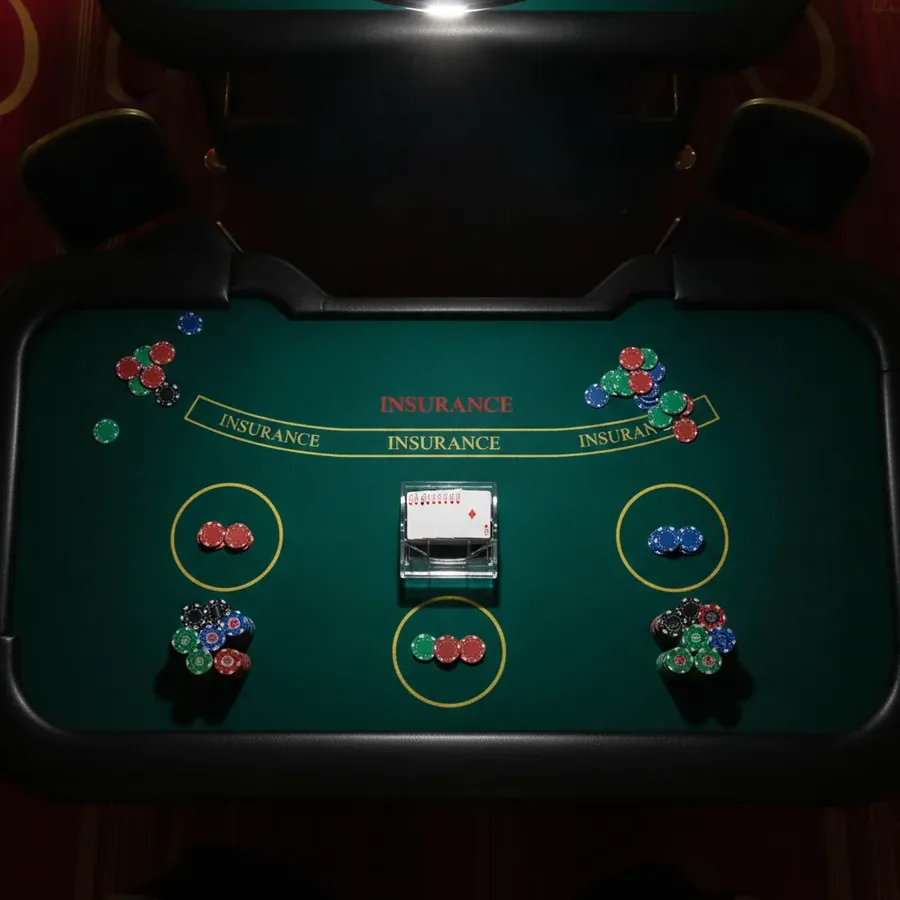
Place Side Bets Before the Cards Are Dealt
Blackjack Insurance is a separate side bet of up to 50% of the main bet, placed when the dealer shows an ace, and pays 2:1 on a successful insurance wager. Its RTP is 92.53% with a house edge of 7.47% across six to eight decks, so a €10 insurance bet costs €0.75 on average. Basic strategy always declines it, and with a single deck the edge narrows to roughly 5.88%.
Compare that 7.47% with the 0.46% house edge of a six-deck S17, DAS, DOA, 3:2 game using basic strategy. Insurance is roughly sixteen times more expensive per euro staked than the main hand, and the 2:1 payout only looks generous because the dealer's ace makes a ten-value card more likely. A player who insures every ace at €10 has €0.75 of expected loss per hand instead of €0.05 on the main bet.
Perfect Pairs and 21+3 are also placed before the deal, in the same window as insurance, and they carry their own house edge rather than the main-hand figure. The step-by-step is fixed: the main bet goes down, the side bet is placed in the marked circle, the cards come out, and the side bet settles on its own rules. Only card counters at a true count of +3 or higher have a reason to take insurance.
RNG Deals From a Virtual Eight-Deck Shoe
An RNG blackjack table draws from a virtual eight-deck shoe, and using six decks instead of eight improves the return by about 0.02 percentage points under the same rules. The Blackjack 6 decks, S17, DAS, DOA, 3:2 game reaches an RTP of 99.54% with a house edge of 0.46%, and basic strategy is required to hit that number. On €100 of stakes, the average cost is €0.46 per hand.
That 0.46% figure sits between the 99.85% RTP of single-deck classic rules at 3:2 and the 98.15% RTP of the six-deck 6:5 game. The eight-deck RNG shoe at 0.46% is the middle option, while the 6:5 payout drags the return down by 1.39 percentage points. Doubling after a split adds about 0.14 percentage points of return, and resplitting aces adds 0.08 percentage points.
Both sit close to the 99.54% of the six-deck RNG game. The step-by-step for the reader is to check the shoe size, the payout ratio and the doubling rules before staking.
Splitting Eights vs Standing on 16
Splitting a pair of eights turns one weak hand into two starting hands, and doubling after a split improves the return by about 0.14 percentage points, while resplitting aces adds 0.08 percentage points. The Blackjack Liberal Vegas Strip rule set combines S17, DAS, resplit and late surrender for an RTP of 99.72% and a house edge of 0.28%. A €10 split with a double on each hand puts €40 at risk across two hands.
Standing on 16 against a dealer's ten is the alternative, and the H17 rule that makes the dealer hit soft 17 costs 0.22 percentage points of return. Late surrender, by contrast, improves the return by about 0.08 percentage points and returns 50% of the stake after the dealer has checked for blackjack. On a €10 hand, surrender returns €5 and ends the round.
Split hands can run to a maximum of four hands, and split aces usually receive one card each, which limits how far the split can be doubled. A double doubles the stake with one card, so the step-by-step is: split, receive the second card on each hand, then decide whether to double. The Liberal Vegas Strip set at 0.28% remains the cheapest place to make those decisions.
Blackjack variants at a glance
| Variant | Payout | House edge | Rule | RTP |
|---|---|---|---|---|
| Blackjack 6 decks, S17, DAS, DOA, 3:2 payout, basic strategy | Blackjack 3:2, regular win 1:1, insurance 2:1 | 0.46% | Dealer stands on soft 17; double down on any first two cards; doubling after a split allowed; no surrender. Basic strategy is required to reach this figure | 99.54% |
| Blackjack Insurance (6–8 decks) | Insurance 2:1 | 7.47% | Separate side bet of up to 50% of the main bet when the dealer shows an ace. Basic strategy ALWAYS declines it (except for card counters at a true count ≥ +3). With a single deck the edge is ≈ 5.88% | 92.53% |
| Blackjack 6:5 payout instead of 3:2 (6 decks) | Blackjack 6:5, win 1:1 | 1.85% | Replacing 3:2 with 6:5 adds exactly +1.39 percentage points to the casino's edge – more than any other rule change. On a €10 bet a blackjack pays €12 instead of €15. | 98.15% |
| Blackjack Surrender (late surrender) – rule effect | 50% of the stake returned | −0.08 percentage points | The player gives up the hand after the dealer has checked for blackjack and loses half the stake. Improves RTP by about 0.08 percentage points. Early surrender is worth much more (up to −0.6 percentage points) but is extremely rare. | n/a (rule modifier) |
| Blackjack Split / double / H17 – rule effects | Double – stake ×2 with one card; split – up to 4 hands; split aces usually get one card each. | H17 +0.22 percentage points; RSA −0.08 percentage points; DAS −0.14 percentage points | Dealer hitting soft 17 lowers RTP by 0.22 percentage points; resplitting aces improves it by 0.08 percentage points; doubling after a split improves it by about 0.14 percentage points; 6 decks instead of 8 – about 0.02 percentage points. | n/a (rule modifiers) |
| Blackjack Single deck, classic rules, 3:2 | Blackjack 3:2, win 1:1 | 0.15% | Fewer decks = lower edge; one deck gives about −0.48 percentage points compared with 8 decks. Often offset by a 6:5 payout. | 99.85% |
One Deck vs Eight Decks: The House Edge Gap
A single-deck blackjack game with classic rules and a 3:2 payout returns 99.85% to the player, which leaves a house edge of just 0.15%, while an eight-deck shoe pushes that edge noticeably higher. Fewer decks means fewer ways for the dealer's composition to favour the house, so the one-deck version keeps only 0.15% of every stake on average. On €100 of stakes, that is a cost of €0.15 per hand, compared with much more at a full eight-deck table.
Cutting from eight decks to one deck improves the return by roughly 0.48 percentage points, a gain that operators often claw back by switching the blackjack payout from 3:2 to 6:5. That single payout change adds 1.39 percentage points to the casino's edge, far more than the deck reduction gives back. A €10 blackjack therefore pays €12 instead of €15, a €3 shortfall that dwarfs the deck benefit.
A six-deck game with S17, DAS, DOA and a 3:2 payout shows how the middle ground performs: RTP 99.54% and a house edge of 0.46%, provided basic strategy is followed. Moving from eight decks to six is worth about 0.02 percentage points, a marginal gain next to the single-deck figure. The practical point is that deck count matters less than the payout ratio printed on the table felt.
Side Bets Raise the House Edge to 5%
Blackjack Insurance is a separate side bet of up to 50% of the main wager, taken when the dealer shows an ace, and it pays 2:1. Despite that tempting payout, its RTP is 92.53%, so the house edge sits at 7.47% on the side bet itself. Insurance is therefore the most expensive bet on the table, and basic strategy always declines it.
With a single deck the insurance edge falls to roughly 5.88%, still far above the 0.46% edge of a well-played six-deck main game. The difference is stark: €100 staked on insurance costs about €7.47 on average, against €0.46 on the main hand. Only card counters tracking a true count of +3 or higher have any mathematical reason to take it.
The 2:1 payout on insurance looks generous, but it only triggers on a dealer blackjack, which is rare. Across a long run of hands, the 92.53% return means the player gives up 7.47 cents on every euro wagered. Treating insurance as a routine add-on turns a low-edge game into one carrying a double-digit cost.
Soft vs Hard Hands in Practice
The dealer's treatment of a soft 17 defines two rule sets: standing on soft 17, known as S17, versus hitting it, known as H17. Hitting soft 17 lowers the return by 0.22 percentage points, which directly raises the house edge. A six-deck S17 game with DAS, DOA and a 3:2 payout returns 99.54% and keeps the edge at 0.46%.
For the player, a soft hand contains an ace counted as eleven, so it cannot bust on the next card; a hard hand has no such cushion. That distinction drives basic strategy: doubling and hitting decisions differ depending on whether the ace is still flexible. The 0.22-percentage-point penalty for H17 translates to €0.22 extra cost per €100 staked over the long run.
A liberal Vegas Strip rule set combining S17, DAS, resplit and late surrender reaches an RTP of 99.72%, leaving a house edge of just 0.28%. The gap between that and a plain H17 six-deck game is 0.18 percentage points. Recognising whether the dealer stands or hits on soft 17 is therefore one of the quickest ways to judge a table before sitting down.
Split, Double Down and Surrender by the Numbers
Doubling after a split, known as DAS, improves the return by about 0.14 percentage points, while resplitting aces adds roughly 0.08 percentage points. Late surrender, where the player gives up the hand after the dealer checks for blackjack and loses half the stake, is worth another 0.08 percentage points. Taken together, these three rules can shift the edge by around 0.30 percentage points.
On a €100 stake, surrender returns €50, so the loss is capped at half the wager instead of the full amount. Early surrender is worth far more, up to 0.6 percentage points, but it is extremely rare on modern tables. Doubling doubles the stake in exchange for one card, and splitting can produce up to four hands, with split aces usually receiving one card each.
A six-deck S17 game with DAS, DOA and a 3:2 payout reaches 99.54% RTP only when basic strategy is applied to every split, double and stand decision. The 0.46% house edge assumes the player uses those rules correctly. Ignoring DAS or surrender gives back the fractions of a percentage point that separate a sharp table from an average one.
Stop the Session After a 30 Percent Loss
A session stop set at a 30% loss means that on a €100 bankroll the player leaves after €30 has gone, and on a €200 bankroll after €60. The figure is a personal threshold, not a rule of the game, but it caps the damage any single sitting can do. Comparing it with the 0.46% house edge on a six-deck S17 game shows how rarely a well-played session should approach that limit.
The maths of variance explains why the stop matters: even at 99.54% RTP, short sessions swing widely around the theoretical return. A 30% loss limit ends the session before those swings compound into a larger drawdown. The 0.15% edge on single-deck classic blackjack gives even more room before the threshold is reached.
Live tables offer a practical frame for the same limit: Blackjack Party from Evolution runs bets from €1.00 to €1,000, while Lightning Blackjack from Evolution spans €1 to €2,500 with an RTP of 99.56%. A 30% stop on a €1,000 bankroll means walking away at €700. Choosing a table whose minimum fits the bankroll keeps the threshold meaningful rather than theoretical.
Bet Two Percent of Your Bankroll per Hand
Two percent of a bankroll means dividing the total playing balance by fifty before each hand, so a player with 500 € puts 10 € on a single blackjack round. The live blackjack tables at The Boss Casino start at 1.00 €, which suits smaller balances, while Blackjack Party from Evolution allows up to 1,000 € per hand. A 10 € stake sits well inside that range and leaves room to adjust after wins or losses.
The single-deck blackjack variant carries a house edge of 0.15%, the lowest figure among the classic tables, and a 100 € stake costs 0.15 € on average over the long run. By contrast, the six-deck game with a 6:5 payout keeps 1.85% of each stake, so the same 100 € of action costs 1.85 €. Betting two percent per hand limits how quickly a losing streak can draw down a balance at either edge.
A 300% welcome bonus up to 2,000 € changes the arithmetic: a first deposit of 500 € adds 1,500 € of bonus money, creating a 2,000 € balance before any blackjack hand is played. Two percent of that combined balance is 40 € per hand, which is four times the 10 € staked from the deposit alone. Players who count the bonus toward their bankroll should recalculate the two percent figure after every session.
Calling Late Surrender Correctly in Three Steps
Late surrender is a rule modifier worth about 0.08 percentage points of house edge, and the procedure has three steps. First, the player waits until the dealer has checked for blackjack; the hand can only be given up after that check. Second, the player announces the surrender before acting on the hand. Third, half the stake is returned and the hand is closed.
Step two matters because timing changes the value. Early surrender is worth up to 0.6 percentage points but is extremely rare, while the late version returns 50% of the stake and improves RTP by roughly 0.08 percentage points. On a €20 bet, a surrendered hand returns €10 instead of risking the full €20.
Step three is the settlement: the loss is capped at half the stake. On the liberal Vegas Strip rule set, which combines S17, DAS, resplit and late surrender, the house edge is 0.28% and the RTP is 99.72%. Surrender is one of the rules that lifts that figure above the 0.46% of the plain six-deck game.
What a Natural Blackjack Actually Pays
A natural blackjack pays 3:2 in the standard game, so a €100 stake returns €150 and a €10 stake returns €15. The 6:5 variant pays only 1:1.2 in practice: on a €10 bet the blackjack pays €12 instead of €15, and the difference of €3 per natural is where the 1.39 percentage point edge increase comes from.
The gap widens with the stake. At €100 per hand, three naturals under 3:2 pay €450, while the same three naturals under 6:5 pay €360, a shortfall of €90. Over a session the 6:5 game runs at 98.15% RTP against 99.54% for the six-deck 3:2 rule set with S17, DAS and DOA.
Single-deck play shows the trade-off from the other side. One deck gives about 0.48 percentage points less edge than eight decks, and the classic single-deck game reaches 99.85% RTP with a 0.15% house edge, but a 6:5 payout is often attached to it. The payout rule, not the deck count, decides what the natural is worth.
Even Money only possible with Dealer Ace
Even money is offered only when the dealer shows an ace, and it is a form of insurance on the natural. Insurance is a separate side bet of up to 50% of the main bet, pays 2:1, and in the six to eight deck game carries an RTP of 92.53% with a house edge of 7.47%. Taking even money locks the natural at 1:1 instead of 3:2.
The arithmetic on a €100 natural makes the cost visible. A 3:2 payout is €150, while even money returns €100, so the player gives up €50 of expected value every time the offer is accepted. With a single deck the insurance edge is about 5.88%, still far above the 0.46% house edge of the six-deck 3:2 game.
Basic strategy always declines insurance except for card counters at a true count of +3 or higher, and the same logic applies to even money. The 2:1 payout on the side bet does not compensate for the 7.47% edge over six to eight decks. Declining keeps the natural's full 3:2 value intact.
Split Aces: Only One Card per Hand
Splitting aces usually gives one card to each hand, and resplitting aces improves RTP by about 0.08 percentage points. A split produces up to four hands, and doubling after a split is worth roughly 0.14 percentage points. The one-card rule on aces is what separates them from every other split pair.
The rules interact in a specific order. Doubling after a split is allowed in the six-deck game with S17, DAS, DOA and a 3:2 payout, which reaches 99.54% RTP and a 0.46% house edge. A six-deck game uses about 0.02 percentage points more edge than an eight-deck game, so the deck count is a minor factor next to the ace rules.
Contact
Live - online chat
Banking









Providers












The Boss Casino 2026